


The cause of psoriasis is unknown, but its development, symptoms, and treatment have been studied in great detail by doctors.Without treatment, the disease progresses, affecting more and more new areas, but sometimes the symptoms are minimal: for example, only the fingers (especially the nails) may be affected.Symptoms of nail psoriasis mostly develop gradually.
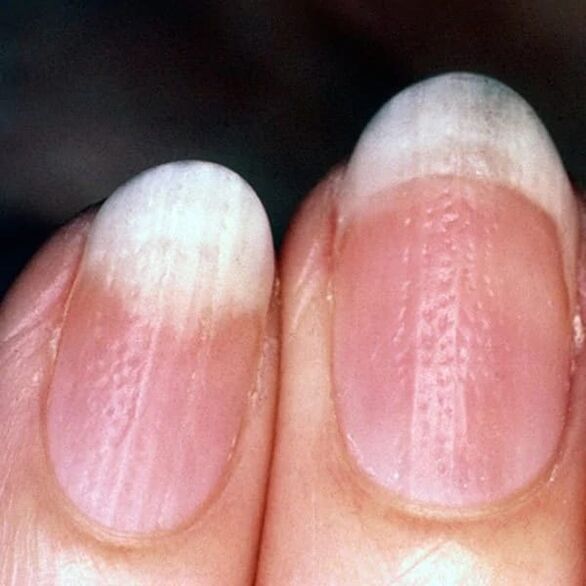
Nail damage due to psoriasis can also be observed when the disease has generally become moderately severe.Regardless of whether this damage is simple or the hospital has affected many areas of the skin, on the fingers it all starts with the nail plate gradually crusting from its edge.Gradually it spreads to the entire nail surface.Stripes often appear on the nail in a vertical or horizontal position, pitted along the entire nail surface.
Over time, the nail plate becomes yellow or gray which is not good for health.Depending on the type of disease, the nails become thinner or thicker, red and eventually black bruises may appear under the nails.When infection occurs, pus appears.Therefore, it is very important not to let the disease reach an advanced stage, but to start treating nail psoriasis in the early stages.
In the final stages of the disease, the nail will gradually peel off from the tissues of the finger.
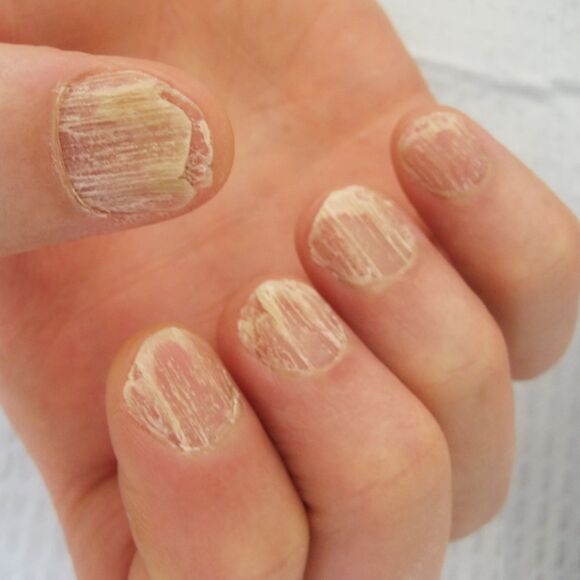
This process starts from the tip of the nail and gradually takes over it completely.In addition, the nail itself can be deformed and take on a different shape - thick and pointed, like a bird's claw, or begin to crumble, becoming thin and brittle.
Psoriasis on fingernails and toenails
Nail psoriasis affects both toes and hands.Psoriasis on the nails is a particularly unpleasant phenomenon for patients.Nail psoriasis presents symptoms so vividly that it causes great difficulty in the patient's daily activities and communication.Complexity and self-isolation arise.
Remember that in addition to treatment, it is imperative to follow special rules of hygiene and daily care.For fingernail or toe psoriasis, you must:
- Always keep your nails clean
- Shorten the nail plate
- Protect your nails from any injury
- Use moisturizer
- Avoid exposure to chemicals, including household chemicals
- Avoid manicures and pedicures
- Cover your nails with a layer of protective clear polish
Nail damage caused by psoriasis on the hands and feet looks extremely uncomfortable and progresses quickly.However, note that patients, even in the later stages of the disease, are not bothered by pain.
Treatment of nail psoriasis
It is imperative to treat psoriasis, wherever it manifests.Nail damage caused by psoriasis cannot be ignored.This is not only a serious cosmetic problem but also a real threat to health.Severely deformed and damaged nails become defenseless against various infections and fungi.Traditional and folk medicine experts know a lot about how to treat nail psoriasis.
Treatment of psoriasis on both skin and nails mainly consists of eliminating external symptoms and generally strengthening the body.Today there are not so many truly effective drugs for nail psoriasis, but they still exist.
Any recommendations on how to treat nail psoriasis always start the same: never, under any circumstances, self-treat.Only a specialist can make an accurate diagnosis and choose the right medication.Nail psoriasis is a very serious disease that requires the attention and supervision of a specialist.If you self-treat, you will spend more money, waste time and as a result, make the condition worse and cause the disease to develop on its own.You need to contact a dermatologist.In the future, consultation with an immunologist and an endocrinologist may be necessary.To determine the cause of the disease, laboratory tests are required.Blood tests are required.
The standard treatment period for nail psoriasis is at least 3 months.That is why the disease cannot turn into a severe form, because in the early stages it does not even require special treatment, but only careful care.